A team hub and SOP portal for a podcast agency with a distributed team
One home for the whole team: processes, the people directory, profiles and internal forms.
We built Fame a team hub: processes, the people directory, user profiles and internal forms in one signed-in place, so new starters find answers themselves and the ops lead stops answering the same questions. Main result so far: 93 people used the hub in the last 30 days.
Who we built it for
Fame is a B2B podcast agency that has been running for six years. Its team finds and books guests, produces episodes and promotes each show for around 100 clients, and Fame Crew finds local videographers for shoots and handles the editing. Team size: about 97 people (estimate), most of them freelancers and contractors. Fame is Forge's own sister company, so we built these tools for ourselves first and still run every one of them.
Who uses it: the whole team, new starters, the ops lead.
The same questions, asked again in Slack
Fame's team works across several countries. How-to guides lived in scattered docs, contact details in a spreadsheet, and forms in a mix of tools. New starters asked the same questions in Slack and the ops lead answered them again.
The ops lead and managers spent around 15 hours a week answering repeat questions (estimate).
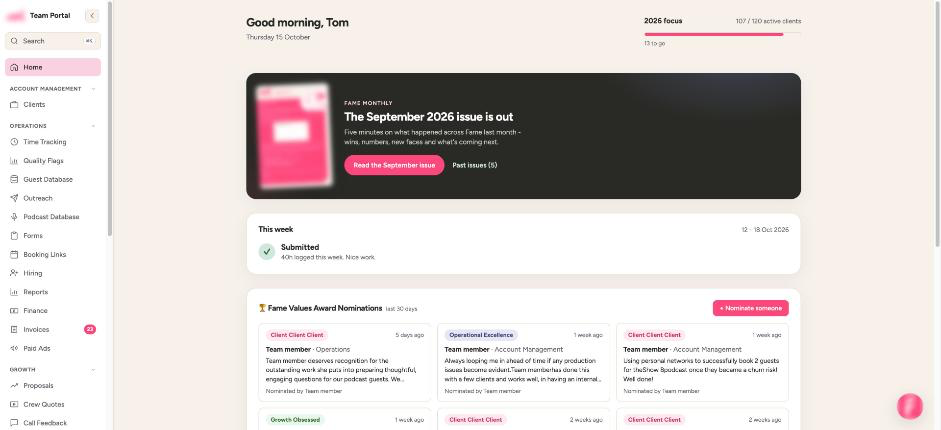
A signed-in home for the team
Processes where the work is
Step-by-step guides for each role, linked from the tools people already use.
People directory and profiles
Who does what, where they are and how to reach them.
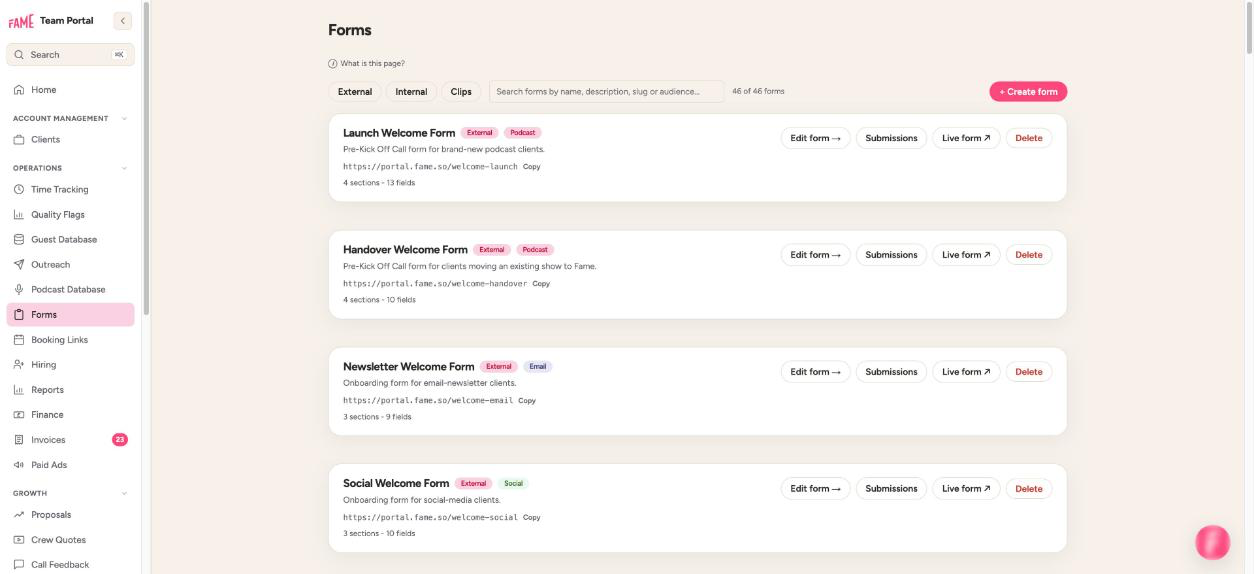
Internal forms
An editor for building forms; responses land in the team's database and the matching Google Sheet.
The front door to everything else
Timesheets, invoicing, reports and the other tools on this page all live inside the hub.
What the ops lead and new starters used before
Scattered docs, a contact spreadsheet and a mix of form tools.
Monthly cost of what came before: £80 a month (estimate)
What changed for the ops lead and new starters
How we look after the team hub
Forge built this for Fame and looks after it: errors are reported automatically to an error tracker, and anything that stops someone doing their job is fixed the same day.
What it's built with
- Next.js
- Supabase
- Vercel
- Google Sheets API
- Sentry
Connects to: Google Sheets, Slack, every other tool on this page.
What it would cost a client today
Start with the 2-week ops audit ($2,500 / £2,000, credited to your first month). A tool like this then fits the starter plan at $2,000 / £1,600 a month, with this as the first build included. A team hub is one team and one clear job, so it fits starter: the first tool built and live, then more one at a time.
Plans have a 3-month minimum. AI usage is passed on at cost, and the tool runs on your own accounts, so you own it. See pricing for the full breakdown.
Would this work for your firm?
Any firm with more than a handful of people and processes that live in someone's head benefits. It suits law firms and accounting firms as well as agencies, wherever new starters need answers fast.
See what we build for law firms, or read about our custom software for small business work.
Questions about building a team hub
Why not just use Notion or a wiki for SOPs?
You can. A custom hub links each process to the tool where the work happens and holds the forms, directory and other tools in the same login, which is why people actually open it.
Can internal form responses go into our existing Google Sheets?
Yes. Fame's forms write each response to the team's database and to the Google Sheet the team already uses.
Who owns the tool once it's built?
You do. It runs on your own accounts and you pay those tool costs directly; we monitor it, fix it and keep improving it on the monthly plan.
How do people sign in?
With their existing work Google account, so there are no new passwords to manage.
Want a team hub shaped to your firm?
Start with a 2-week ops audit - $2,500 / £2,000, credited to your first month.