A client portal for a podcast agency, built around the questions clients actually ask
One login where every client sees their show: episodes, guests, approvals and results.
We built Fame a client portal: each client signs in to see their episodes, guest pipeline, approvals and results in one place, so account managers spend less time writing status updates. Main result so far: 2,111 portal views by clients in the last 30 days, across 87 client accounts.
Who we built it for
Fame is a B2B podcast agency that has been running for six years. Its team finds and books guests, produces episodes and promotes each show for around 100 clients, and Fame Crew finds local videographers for shoots and handles the editing. Team size: about 97 people (estimate), most of them freelancers and contractors. Fame is Forge's own sister company, so we built these tools for ourselves first and still run every one of them.
Who uses it: clients, account managers.
Account managers were the only way clients could see their show
Before the portal, a client who wanted to know which guests were booked, which episodes were waiting for sign-off or how the show was doing had to ask their account manager. The answers lived in a shared tracking spreadsheet, a Trello board and the review tool, so each question meant opening three places and writing an update by hand.
With around 100 clients, that made account managers a relay service. Account managers spent around 40 hours a week between them writing status updates (estimate).
A portal that answers the client's questions before they ask
One home per client
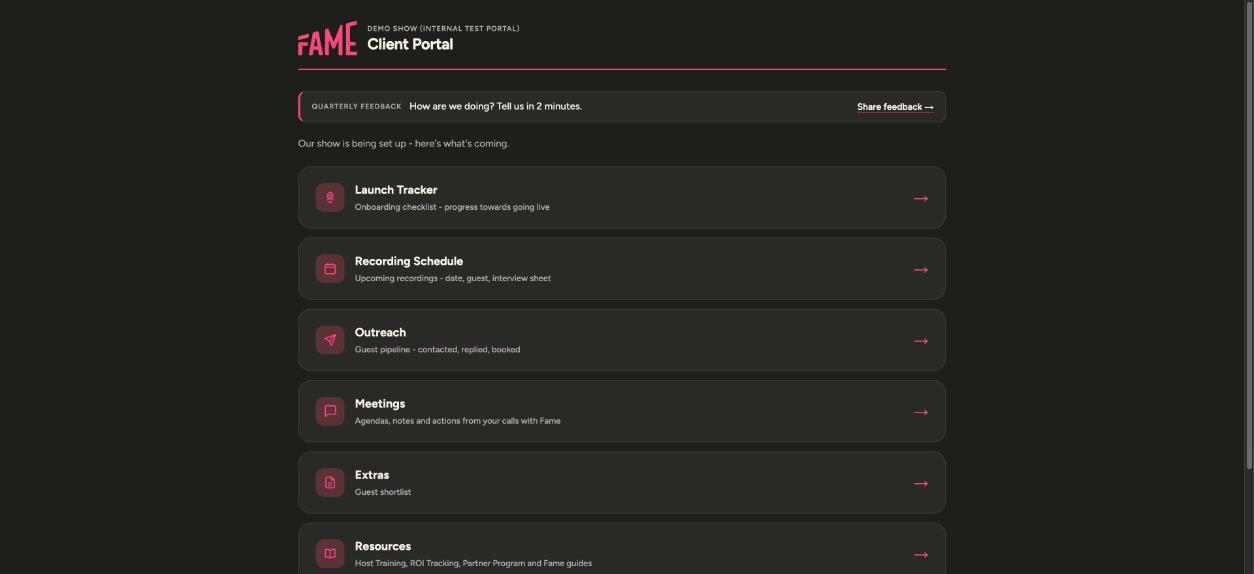
Each client signs in to their own portal with their show's episodes, guest pipeline and results in one place.
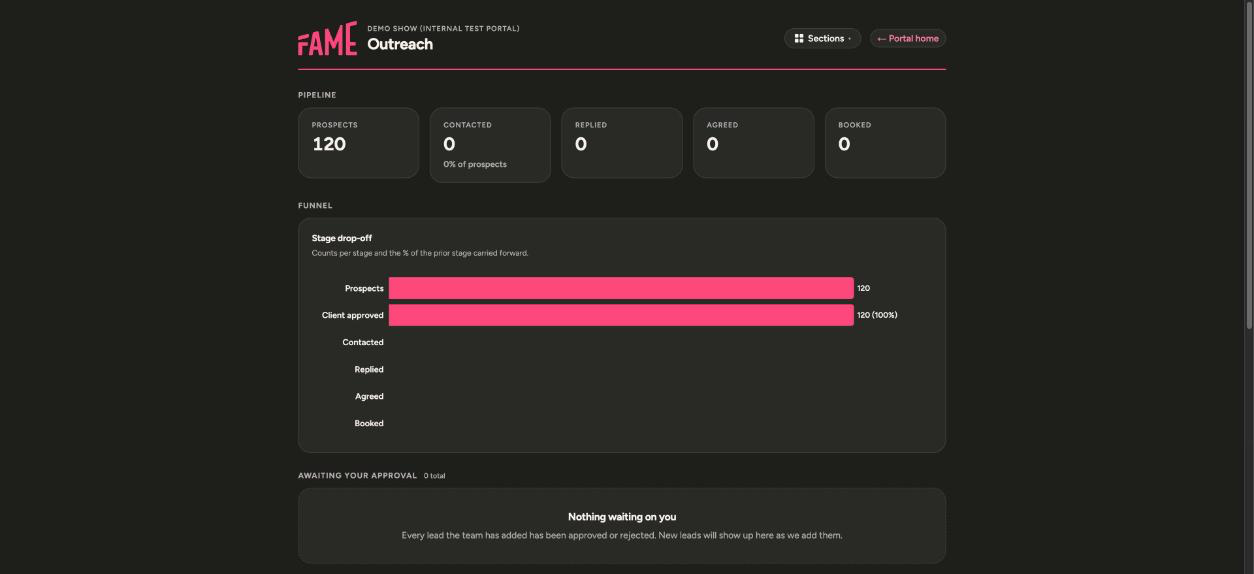
Guest pipeline from the tracker
The guest outreach list is read from the same tracking sheet producers already use, so nobody types it twice.
Approvals in place
Episodes and assets waiting for the client link straight into the review tool, so sign-off happens where the work is.
Results next to the work
Show results sit beside the episodes they came from.
What the account managers used before
Status emails written by account managers from a shared tracking spreadsheet, a Trello board and the review tool.
Monthly cost of what came before: £0 a month (estimate)
What changed for the account managers
How we look after the client portal
Forge built this for Fame and looks after it: errors are reported automatically to an error tracker, and anything that stops someone doing their job is fixed the same day.
What broke, and how we fixed it
- 6 October 2026: A shared access token for the project board stopped working, so episode submissions from one client form saved but never reached the team's board. We swapped it for a token owned by an account that won't be closed. The portal now records the outcome of every submission, alerts the team when one fails and retries failed ones every hour.
What it's built with
- Next.js
- Supabase
- Vercel
- Google Sheets API
- Trello API
- Sentry
Connects to: the shared tracking spreadsheet, Trello, the asset review tool.
What it would cost a client today
Start with the 2-week ops audit ($2,500 / £2,000, credited to your first month). A tool like this then fits the growth plan at $3,500 / £2,800 a month, with this as the first build included. A portal touches several existing apps and every client, so it usually sits on growth, where two builds can run at once and small changes come back in 2 working days.
Plans have a 3-month minimum. AI usage is passed on at cost, and the tool runs on your own accounts, so you own it. See pricing for the full breakdown.
Would this work for your firm?
If your clients regularly email to ask where things are, a portal gives that time back to the people answering. It suits any agency delivering recurring work to many clients, and the same pattern works for accountants and consultancies chasing client documents.
See what we build for agencies, or read about our custom software for small business work.
Questions about building a client portal
How long does it take to build a client portal for an agency?
The first version is the first build on your monthly plan, scoped during the 2-week ops audit. For Fame's portal, it took about 6 weeks (estimate) from start to first clients signing in.
Can a client portal pull from the spreadsheets we already use?
Yes. Fame's portal reads its guest pipeline from the same tracking spreadsheet the producers use and links into the review tool, so the team keeps working where it already works.
Who owns the tool once it's built?
You do. It runs on your own accounts and you pay those tool costs directly; we monitor it, fix it and keep improving it on the monthly plan.
Is an off-the-shelf client portal cheaper?
Often, at first. Off-the-shelf portals show generic projects and files; a custom one shows your stages and your data, which is what stops the status emails.
Want a client portal shaped to your firm?
Start with a 2-week ops audit - $2,500 / £2,000, credited to your first month.