A client health score and churn alerts for an agency with around 100 clients
A health score for every client built from real signals, early churn warnings, and a timeline of everything that happened on the account.
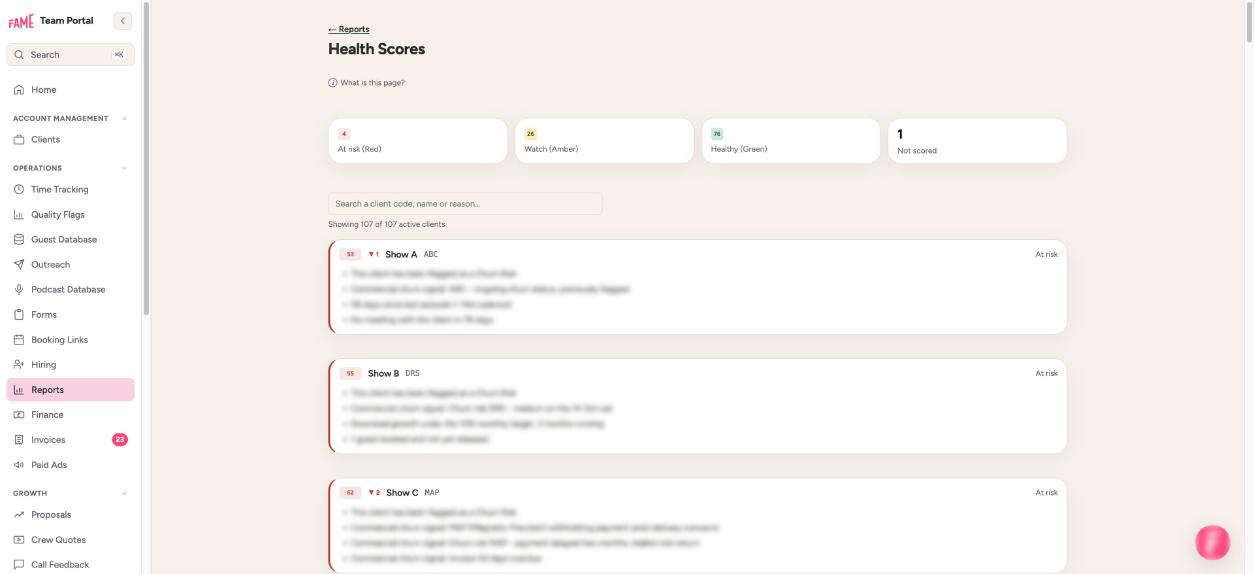
We built Fame a health score for every client, worked out from meetings, emails, approvals, comments and handovers, with early churn warnings and a per-client timeline, so account managers see trouble coming and spend less time piecing together history. Main result so far: 18,592 health scores worked out for 185 client accounts since June 2026.
Who we built it for
Fame is a B2B podcast agency that has been running for six years. Its team finds and books guests, produces episodes and promotes each show for around 100 clients, and Fame Crew finds local videographers for shoots and handles the editing. Team size: about 97 people (estimate), most of them freelancers and contractors. Fame is Forge's own sister company, so we built these tools for ourselves first and still run every one of them.
Who uses it: account managers, the founder.
Churn showed up as a surprise
With around 100 clients, an account manager couldn't keep every signal in their head: a cancelled call here, a terse email there, a run of slow approvals. Those signals sat in Trello, Gmail, meeting notes and the review tool, and only came together when a client gave notice.
Account managers spent around 10 hours a week pulling client history together (estimate).
Every client signal in one place
Health score
A score per client from seven weighted signals, updated automatically.
Churn signals
Warnings from handovers, feedback forms and inbox tone, weighted by who sent them.
Activity timeline
Meetings, emails, approvals and comments for each client in date order.
What the account managers used before
Piecing together client history from Trello, Gmail, meeting notes and the review tool.
Monthly cost of what came before: £0 a month (estimate)
What changed for the account managers
How we look after the client health score and churn signals
Forge built this for Fame and looks after it: errors are reported automatically to an error tracker, and anything that stops someone doing their job is fixed the same day.
What broke, and how we fixed it
- 15 June 2026: The weekly AI reviews that feed the churn reports came back blank one Monday: three scheduled jobs were being bounced to a login page, and the email review ran out of time as email volume grew. We let the scheduled jobs through, gave the email review more time to finish, and now keep a rule that every scheduled job is on the allow list.
What it's built with
- Next.js
- Supabase
- Vercel
- Anthropic Claude
- Gmail API
- Trello API
Connects to: Trello, Gmail, meeting transcripts, the asset review tool.
What it would cost a client today
Start with the 2-week ops audit ($2,500 / £2,000, credited to your first month). A tool like this then fits the growth plan at $3,500 / £2,800 a month, with this as the first build included. A health score pulls from several sources at once, so it usually fits growth.
Plans have a 3-month minimum. AI usage is passed on at cost, and the tool runs on your own accounts, so you own it. See pricing for the full breakdown.
Would this work for your firm?
If you have more clients than one person can keep in their head, a health score gives account managers an early warning. It suits consultancies and agencies on retainers most.
See what we build for consultancies, or read about our AI consulting for small business work.
Questions about building a client health score and churn signals
What signals go into a client health score?
For Fame: meetings, emails, approvals and comments in the review tool, handovers, feedback forms and host engagement, each weighted.
Does AI decide which clients are at risk?
AI summarises the signals; account managers decide what to do. AI drafts, people decide.
How quickly does a signal show up?
Most sources update daily; the AI reviews run weekly on Monday mornings.
Who owns the tool once it's built?
You do. It runs on your own accounts and you pay those tool costs directly; we monitor it, fix it and keep improving it on the monthly plan.
Want a client health score and churn signals shaped to your firm?
Start with a 2-week ops audit - $2,500 / £2,000, credited to your first month.